MINI WAR COMMAND ARCHIVEUPDATED: MAY 2026PLAYER STRATEGY NOTES
Mini War Game Systems - Complete Mechanics Reference
In Mini War, you aren't just building a base; you are managing a fragile, interconnected war machine. Every single system—Economy, Military, Territory, and Tech—feeds into each other. If one cog rusts, your entire match grinds to a halt.
This reference breaks down the hidden mechanics, game loops, and optimization checklists you need to dominate public and competitive lobbies.
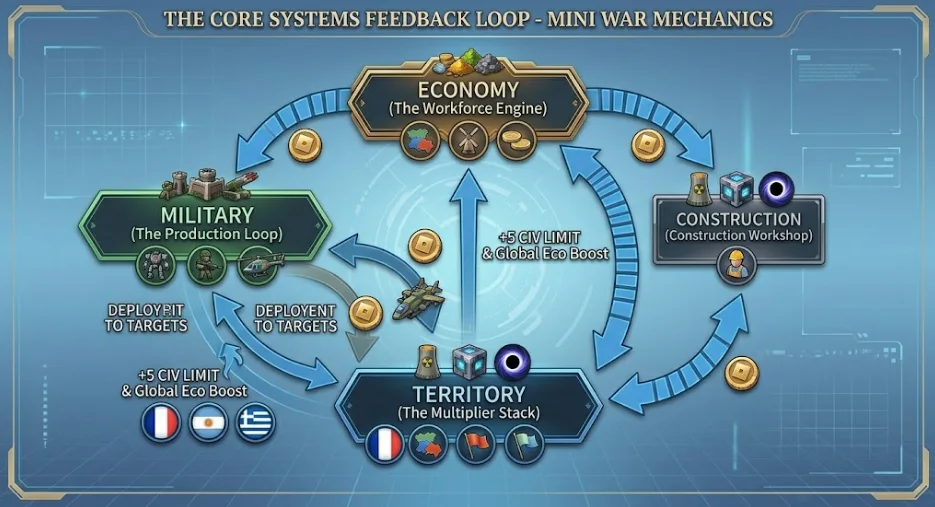
The Core Systems Feedback Loop
Complete Game Systems Breakdown
To completely master the match tempo, you must understand the exact rolling mechanics of all 7 individual systems running under the hood:
The Blueprint: Dictates how your home plot scales from zero to billions. Everything relies on balancing housing infrastructure (Farmhouses/Skyscrapers) with production lines (Wheat Farms, Uranium Caves, Antimatter Reactors).
The Alpha Rule: Factories do not generate income automatically. If your population is completely wiped out by an enemy Air Rush or if workers are unallocated, your high-tier industrial nodes will instantly sit at zero production.
The Blueprint: Manages unit spawning, damage tracking, and supply caps. Your barracks and mech stations will continuously cycle-spawn troops up to your current maximum Army Size.
The Alpha Rule: Low-tier ground infantry is pure meat-shield filler. Late-game lobbies are entirely won by utilizing Apache Helicopters to snipe civilian infrastructure and high-DPS automated Mechs backed by map-wide Nuke Silos.
The Blueprint: Governs how you expand your borders outwards by capturing neutral NPC nations (France, Argentina, Greece) or invading rival player plots.
The Alpha Rule: Every territory flag secured grants an immediate +5 Civilian cap and a 5% Global Money Multiplier. Never leave a freshly captured plot unguarded; NPC units respawn on a fixed timer and will easily claw back the territory if you don't park a heavy garrison on the point.
The Blueprint: The progression system that upgrades your empire's base efficiency using dedicated Scientists in your Research Labs.
The Alpha Rule: Do not blindly queue tech. Prioritize Fast Workers (+10% Crop Gen) and Rapid Logistics early to keep building speeds fluid, then rush Army Control to unlock tactical squad targeting so your units don't wander into enemy tower grids like headless chickens.
The Blueprint: Choosable commander personas that grant passive stat buffs and high-impact active abilities tailored to specific strategy archetypes.
The Alpha Rule: Match your general directly to your opening build order. Running an economy-boosting commander while executing an early Air Rush completely wastes your early-game timing windows.
The Blueprint: The diplomacy layer enabling you to send alliance requests, share radar vision, trade resources safely, and organize coordinated multi-front pincer attacks on the center map.
The Alpha Rule: Do not accept random public alliance requests blindly. True value comes from using the alliance system to pool resources, enabling one player to fast-track to late-game Nuke tech while the other acts as a defensive turtle buffer.
The Blueprint: Controlled by the map's NPC Tradesman. It handles the resource-to-cash conversion rates that dictate when you should dump your stocks.
The Alpha Rule: Selling resources immediately as they generate is a major throw. Hoard high-value cargo like Data Cubes and Stable Uranium, and dump your entire inventory only when the market triggers a +20% to +50% Price Spike Event.
Live-Match Decision Tree: Reading the Game State
Mini War games are won or lost based on Tempo. A massive econ build means nothing if a surprise attack wipes your base before your first factory finishes building.
Situation A: You are Crushing It (Ahead on Macro)
Do Not: Sit on a mountain of unspent gold waiting to buy the perfect crate. Floating cash is a throw.
Do: Hard-pivot that excess income into permanent, un-removable advantages. Max out your Research Tree tiers, drop redundant Giant Skyscrapers to bulletproof your civilian cap, and prepare a secondary defensive wall of Sniper Towers in case of a server-wide event flip.
Situation B: You are Behind (Getting Cooped Up)
Do Not: Blindly throw basic infantry squads into the center map to contest the high-tier boss rewards. You are just gifting the lobby free tempo.
Do: Strip your game plan down to immediate survival. Lock your units inside your home plot, pop 2 Watchtowers at the choke point, activate Auto-Sell, and wait out a Market Price Spike (+25% to +50%) or global event to cash in your stored resources and fund an emergency tech shift.
System Integration Under Global Events
Your entire layout must adapt the second the global server engine shifts the environment.
Riot Weather (The Chaos Flip)
The Trigger: Map goes pitch black, helicopters start roaming, and random production nodes catch fire, slicing their output by 50%.
The System Synergy: This event heavily rewards the Military + Market systems. While your farms are burning, your market receives a 20% to 30% Price Boost. Take your current army supply, crush the temporary Riot Outposts for a 100% Riot Case drop, and dump your inventory to the Tradesman for double the cash value.
Nuclear Fallout (The Radiation Pivot)
The Trigger: A 13-minute green fog blankets the lobby.
The System Synergy: Randomly strikes individual nodes with a +50% Production Boost. Check your Uranium Caves and Antimatter Reactors immediately. If they have the green radiation indicator, instantly pull civilians off lower-tier structures and stack them onto the radiated nodes. Keep a squad of Special Forces on your base borders to clear out wandering Zombies spawned by the fallout.
Frequently Asked Questions
Why is my high-tier factory (e.g., Black Hole Generator) showing 0 production?
Check your civilian population allocation. If your housing units are completely destroyed or if your worker pool is fully assigned to basic Wheat/Carrot farms, your high-tier industrial nodes will have zero staff and won't produce a single item.
What is the single biggest bottleneck that causes mid-game throws?
Army Control neglect. Players build expensive Mech Spawners but forget to run the Army Control tech in the Research Tree. Without it, your high-tier, high-cost units will just wander aimlessly in circles around your home base or get easily baited and melted by cheap static enemy defense lines.